

Why Kithure Kindiki Is Standing Firmly Behind William Ruto
Why is Kithure Kindiki standing firmly behind William Ruto? Explore their political partnership, Mt Kenya politics and the 2027 and 2032 succession debate.
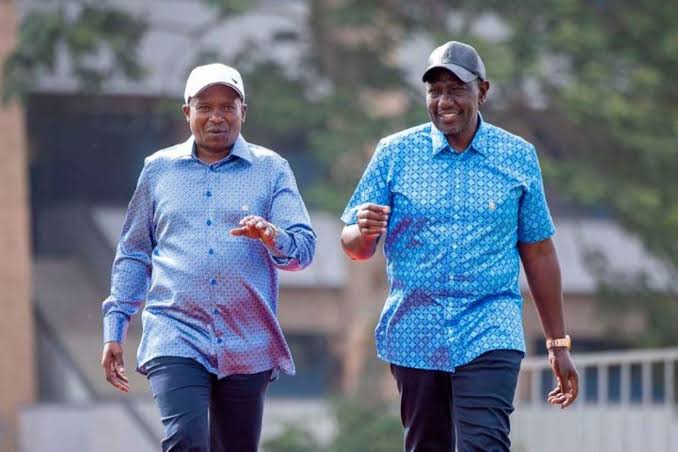
Deputy President Kithure Kindiki's unwavering support for President William Ruto is emerging as a defining feature of Kenya's political realignments ahead of the 2027 General Election, raising questions about the political calculations, ambitions and long-term interests shaping their relationship.
At a time when the Mt Kenya political landscape remains divided following the impeachment of former Deputy President Rigathi Gachagua, Kindiki has chosen to strengthen his association with Ruto rather than distance himself from an administration facing growing political challenges.
His repeated declarations of support for Ruto's re-election, defence of government policies and mobilisation efforts across the Mt Kenya region point to a political partnership that could extend beyond the 2027 elections.
But is Kindiki's loyalty to Ruto driven by personal conviction, political strategy or an understanding that his own presidential ambitions could depend on the success of the current administration?
The question carries significant political weight because Kindiki is not merely serving as Ruto's deputy. He is increasingly becoming an important figure in the government's efforts to consolidate support in Mt Kenya, a region whose voting patterns could have a considerable influence on the 2027 presidential contest.
For Kindiki, the relationship presents an opportunity to strengthen his national political profile while positioning himself within conversations about the country's leadership beyond Ruto's second term.
For the President, having a deputy who consistently defends his administration provides an important political advantage as he seeks to maintain the coalition that brought him to power in 2022.
Kindiki's appointment as Deputy President changed the Mt Kenya political equation
To understand Kindiki's loyalty to Ruto, it is necessary to examine how he rose to the country's second-highest office.
Before becoming Deputy President, Kindiki served as Interior Cabinet Secretary in Ruto's administration. His political fortunes changed significantly in October 2024 following the impeachment of Gachagua, who had become increasingly estranged from the President.
Ruto subsequently nominated Kindiki to replace Gachagua, with Parliament approving his appointment before he was sworn in on November 1, 2024.
The appointment represented a major political shift in Mt Kenya, transferring the region's representation in the Deputy Presidency from Gachagua to Kindiki.
It also gave Ruto an opportunity to establish a new political relationship with a region that had overwhelmingly supported his presidential bid in 2022 but was experiencing growing divisions within its leadership.
For Kindiki, the appointment was a major elevation from the Cabinet to the centre of national executive power.
His continued loyalty can therefore be understood within the context of a political partnership built around shared interests.
Ruto needs a deputy capable of defending his administration and mobilising support in Mt Kenya, while Kindiki benefits from the national visibility, political influence and leadership experience associated with the office.
The relationship has created a political arrangement in which both leaders have reasons to maintain their partnership.
However, its durability will ultimately depend on whether their political interests remain aligned as the country approaches another election.
Why Kindiki is defending Ruto's re-election
One of the clearest indications of Kindiki's political position has been his repeated insistence that Mt Kenya should support Ruto's second-term ambitions.
Rather than adopting a neutral position amid disagreements between Ruto and Gachagua, Kindiki has increasingly presented himself as one of the administration's principal defenders in the region.
His argument is largely anchored on development, political representation and the need for Mt Kenya to remain part of the national government.
The Deputy President has maintained that the region should not abandon an administration in which it has representation, particularly when government projects and programmes are being implemented across the country.
This approach is important because the Mt Kenya political contest is no longer simply about who commands the region's political loyalty. It is also about competing arguments over whether the community should remain within government or join the opposition.
Kindiki's strategy is to make continued participation in government the central argument for supporting Ruto.
For him, political disagreements should not automatically translate into withdrawing support from the administration.
This position also helps him distinguish his leadership approach from that of Gachagua, who has positioned himself as a critic of the government following his removal from office.
The Gachagua factor and Kindiki's battle for Mt Kenya
The political fallout following Gachagua's impeachment has created two competing political approaches in Mt Kenya, with Kindiki positioning himself within government while his predecessor seeks to build an opposition movement through the Democracy for the Citizens Party (DCP).
Gachagua has continued to challenge Ruto's leadership, arguing that the region's political interests have not been adequately protected. His message has found an audience among sections of Mt Kenya voters who feel that the community's political influence has diminished since his removal.
Kindiki, on the other hand, has chosen to defend the government's record and persuade residents that remaining within the Kenya Kwanza administration offers greater opportunities for regional development and political representation.
This is perhaps the biggest political test facing the Deputy President.
He must demonstrate that his position in government translates into tangible benefits for Mt Kenya while convincing voters that supporting Ruto does not amount to abandoning their regional political interests.
His challenge is complicated by the fact that Gachagua remains a significant political figure in the region and has established an alternative political platform through DCP.
Consequently, Kindiki's loyalty to Ruto is also a test of whether the Deputy President can build a political following independent of the traditional political structures that have shaped Mt Kenya politics.
Is Kindiki positioning himself for the 2032 presidential race?
Beyond the immediate contest for the 2027 elections, Kindiki's relationship with Ruto raises an even bigger question about Kenya's 2032 presidential succession.
The Deputy President has increasingly featured in discussions about Mt Kenya's prospects of producing the country's next president after Ruto completes his constitutional two-term limit, should he secure re-election.
For a politician occupying the second-highest office, such conversations are difficult to ignore.
Remaining close to Ruto could give Kindiki an opportunity to gain executive experience, establish relationships across the country and build a national political profile.
It could also position him as a potential beneficiary of the political networks and alliances being constructed within Kenya Kwanza.
However, succession politics is rarely straightforward.
Ruto's second-term ambitions, if successful, would not automatically translate into an agreement on who should succeed him. Other political leaders within the ruling coalition could also seek the presidency, creating competing interests as the 2032 elections approach.
Kindiki therefore faces a delicate balancing act.
He must demonstrate that he is committed to Ruto's immediate political ambitions without allowing his own long-term political identity to disappear within the President's shadow.
His political future may depend on how successfully he manages that balance.
Development politics: Kindiki's biggest argument for supporting Ruto
Another important feature of Kindiki's political strategy is his emphasis on development projects as evidence of the benefits of remaining in government.
Across Mt Kenya, the Deputy President has increasingly used government infrastructure programmes, road construction, agricultural interventions and other development initiatives to defend Ruto's administration.
His argument is that political support should be informed by what the government is delivering rather than disagreements among individual politicians.
This approach is particularly relevant in a region where agriculture, infrastructure, employment and the cost of living remain central to public concerns.
For example, Kindiki has highlighted government interventions in the coffee and dairy sectors, including changes in coffee cherry payments, milk prices and fertiliser costs.
He has also used major infrastructure projects, including the proposed Muthaiga-Kiambu dual carriageway and other road development programmes, to demonstrate the administration's investment in the region.
These projects provide him with a political argument that goes beyond defending Ruto personally.
He is effectively asking Mt Kenya voters to evaluate the administration through its development record and determine whether remaining within government serves their interests.
However, this strategy carries a risk.
Development announcements do not automatically translate into political support. Residents will ultimately judge the administration by whether projects are completed, agricultural earnings improve, employment opportunities expand and the cost of living becomes manageable.
For Kindiki, the success of development politics will depend on the gap between government promises and what ordinary Kenyans experience.
Is Ruto equally invested in the Kindiki partnership?
While much attention has focused on Kindiki's loyalty to Ruto, another important question is whether the President views the relationship as a long-term political partnership.
The Deputy Presidency is an influential political position, but it also depends heavily on the President's confidence and the political arrangements within the ruling coalition.
Kindiki's continued defence of Ruto provides the President with a dependable political ally, particularly in efforts to rebuild support in Mt Kenya.
But the question of whether the current partnership will survive beyond 2027 remains open.
The running-mate question will be particularly important as the country approaches the next election.
Kindiki has publicly expressed confidence in continuing alongside Ruto in 2027, signalling that he considers their political arrangement intact.
However, political parties and coalitions frequently review their electoral strategies based on changing regional interests, negotiations and the demands of building a winning national alliance.
The Deputy President's position will therefore depend not only on his loyalty but also on the political value both leaders attach to maintaining the partnership.
Political loyalty or a calculated investment in the future?
Kindiki's political journey presents an interesting case of how loyalty, ambition and political survival can operate together.
His support for Ruto may reflect a genuine belief in the administration's agenda. It may also be informed by the understanding that remaining close to the President offers him the strongest platform to consolidate his political position.
There is no contradiction in pursuing both objectives.
In fact, the relationship could represent a calculated long-term partnership in which Ruto secures a deputy committed to defending his administration while Kindiki gains an opportunity to strengthen his leadership credentials.
But there are uncertainties.
The 2027 General Election will test whether Kindiki can translate his government position into sustained political support in Mt Kenya. It will also reveal whether his development-centred message can compete with the opposition's criticism of the administration.
Beyond that, the 2032 succession debate could become the ultimate test of the relationship.
If Ruto secures another term and the partnership remains intact, Kindiki could emerge from the next political cycle with greater national visibility and executive experience.
However, if competing ambitions emerge within Kenya Kwanza, the Deputy President may find that loyalty alone cannot determine his political future.
Ultimately, Kindiki's loyalty to Ruto may not be a choice between personal conviction and political strategy. It could be both: a commitment to the President today and an investment in his own political future tomorrow.
The bigger question is whether the partnership will remain mutually beneficial when the conversation shifts from securing Ruto's second term to deciding who takes over the country's leadership in 2032.